When we had the VW T25Camper, the electrics were rudimentary at the best and caused problems.
The Perentie will require much more power, so I spent a lot of time thinking about and calculating exactly what power would be required and how to store sufficient when we were off grid.
I am not going to cover the detail here as this has been done many time before and can be found easily on You Tube. However, it is not all correct………I would recommend Greg Virgo’s channel on You Tube. I will just explain what I did and why.
I do not want to carry gas as a permanent fixture, partly because I have no room, secondly and more importantly; I don’t like it from a safety point of view. Different fittings in different countries are a complication and I don’t want the hassle in the USA. A portable gas burner used whist in the UK, will be fine though, for occasional use.
So, I wanted enough power to be able to use a low powered kettle and induction hob, if not connected to the grid; even to save the cost of an electric hook up for an overnight stay. We would be driving most days, so keeping batteries charged should not be as issue, especially as I am planing solar as well.
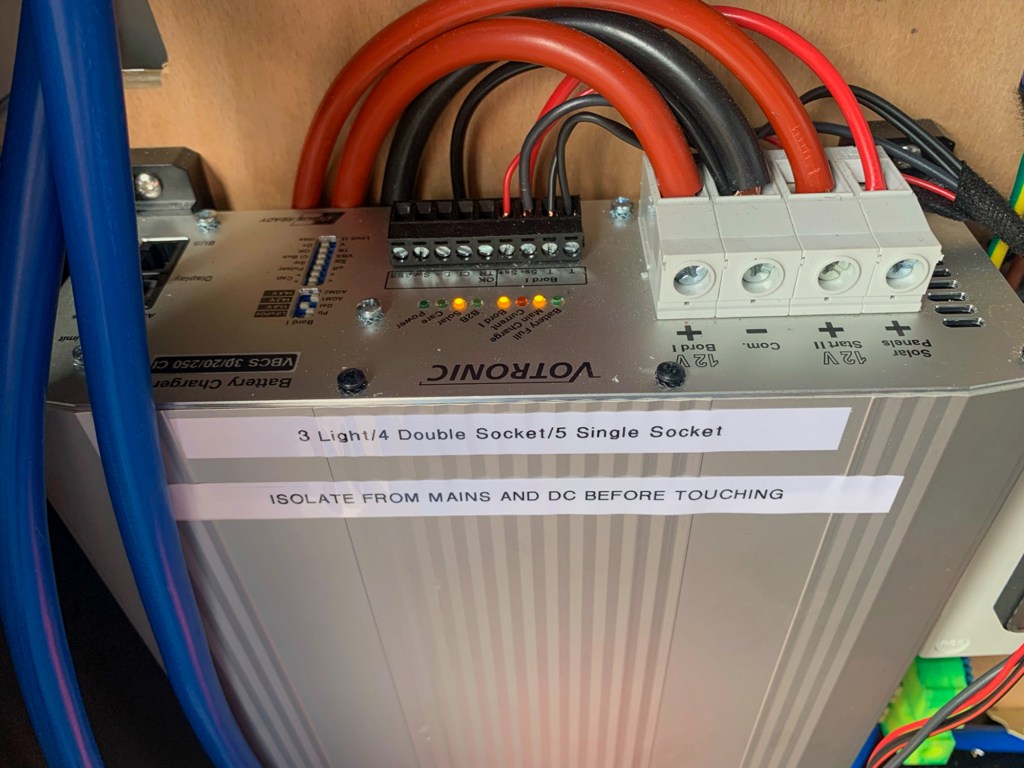
So the core of the system is a Votronic 3 way DC to DC charger which is a compact unit and negates the need for a separate Solar Controller. It will intelligently charge the leisure and starter batteries when the vehicle is running, from solar and from a 240v/110v supply when plugged in.
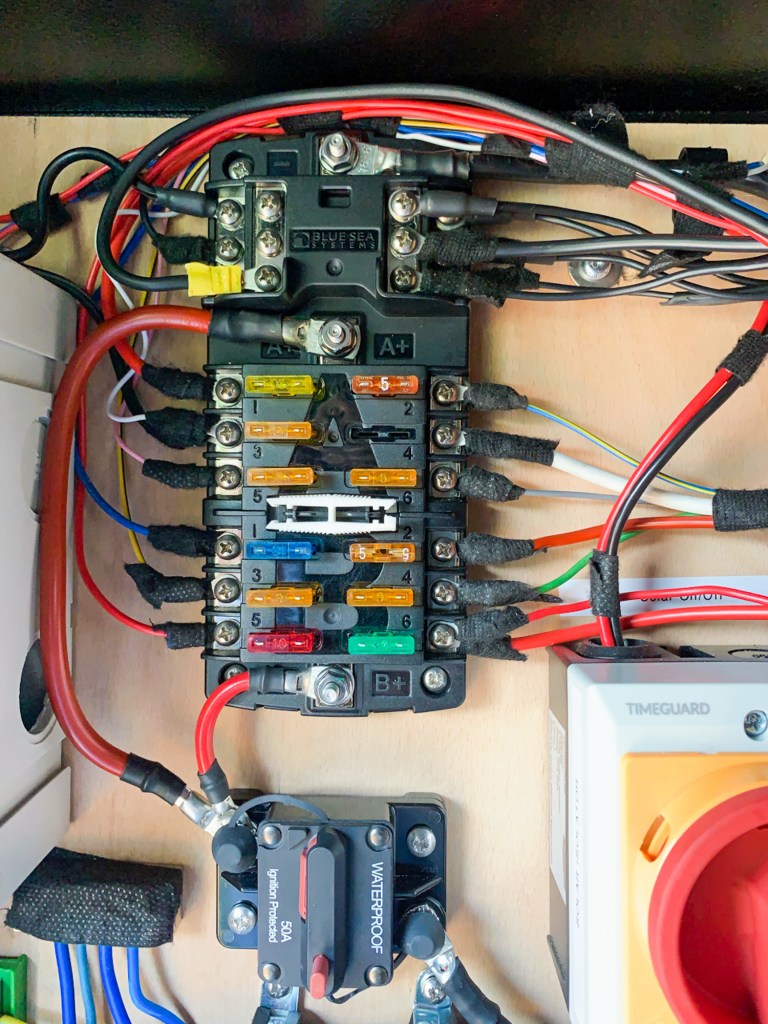
The 12v supply was easy. I used a Blue Sea fuse box with a common earth from the leisure batteries with a 50a breaker for protection. This gave me 12 x 12v circuits which was just enough. (I did have to double up on the LED lights, but these draw hardly any power).
With the 240v, I wanted to be able to easily switch between mains (shore) power and the 240v supply that was being provided by the inverter when off-grid. Therefore having only one set of 240v wiring. I was only running three 240v circuits, one for a light, one for a double socket with USB points and one for the water heater (see separate post).
So I split the shore power coming in. One supply went to the Votronic Charger and another to a 2 Way double pole isolator switch.

The output from the inverter also went to the double pole isolator switch, so I could choose the source of my 240v supply. The output from the switch goes to a distribution board for the 3 x 240v circuits that have their own RCD. This means I can add more 240v circuits later , if needed.
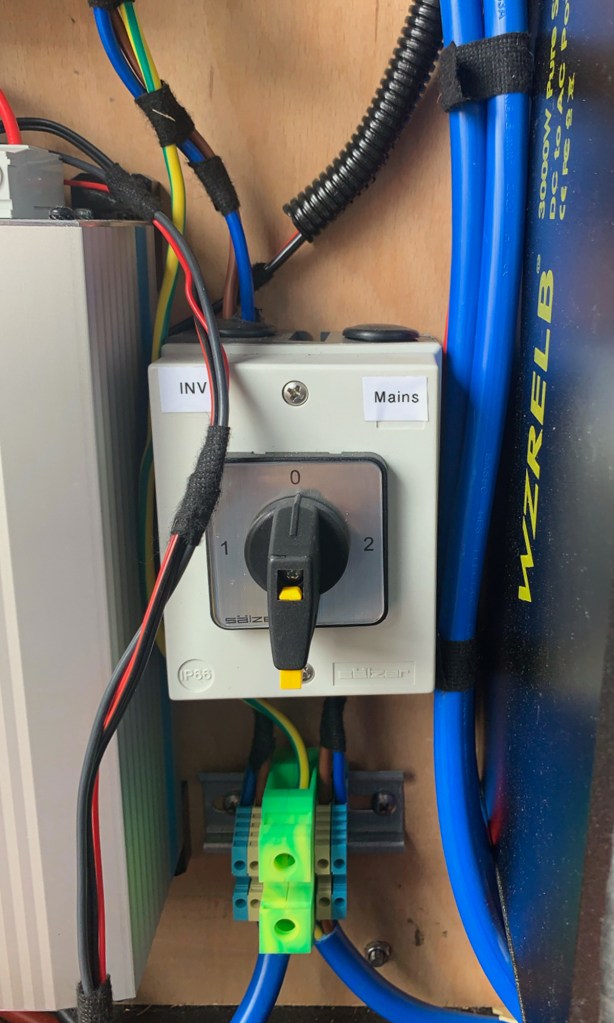
Double Pole Isolater 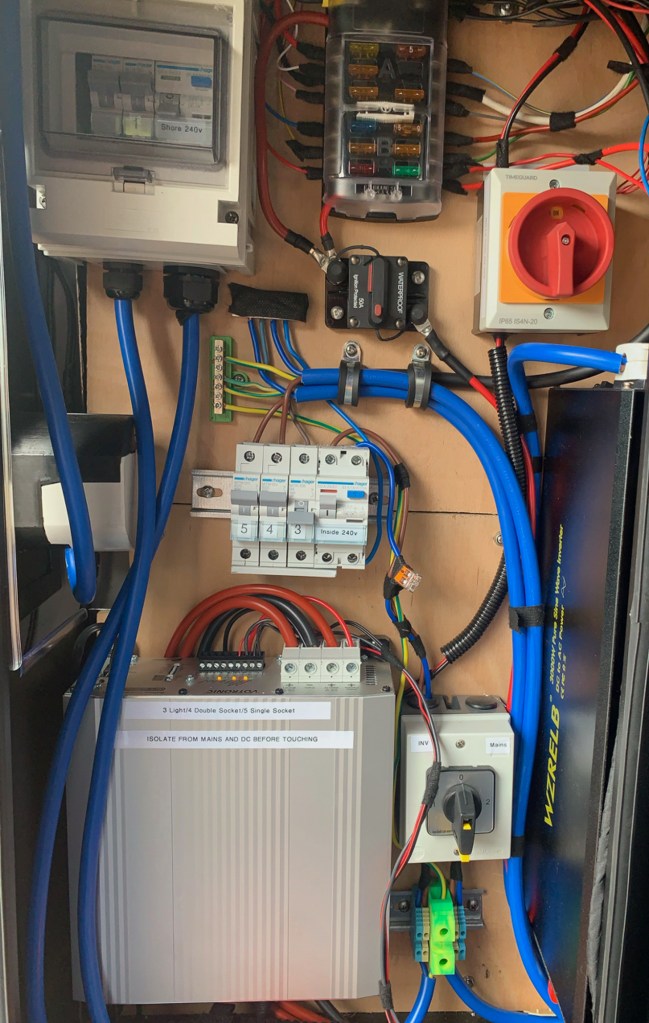
RCD’s for the 240v Circuits
Thus all added up to quite a few wires. You have power in from the Solar which is fitted with an isolator as it is always live. Then power out to the starter and leisure batteries with an earth. Then you are feeding power back from the leisure batteries to the 12v fuse box and the inverter. The inverter is 3000w so a big cable with a 250w breaker. There are also a few wires for battery monitoring and others that I needed to run to the front of the vehicle, so I can switch them from there e.g. A rear light and the water heater.
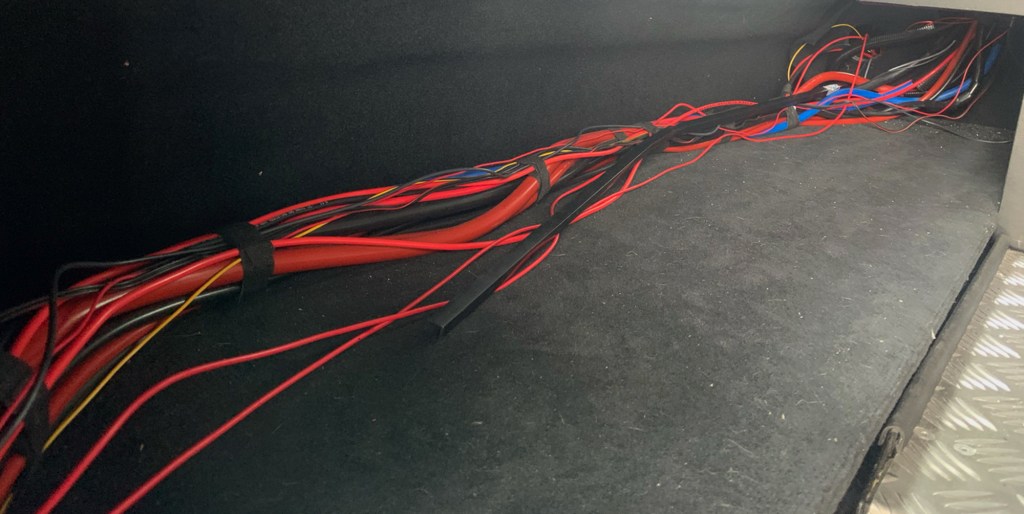
I fitted all of the electrics into a cabinet that we got with the vehicle, this was placed just inside the rear door, on the passenger side. I had previously run the wires that would need a 12v supply to this location.
The water will go in an identical cabinet on the drivers side.
 48 States of Gray